

The Complete Guide to Revenue Cycle Success in Healthcare
Healthcare providers dedicate their lives to improving patient health, but delivering quality care is only one part of running a successful practice. Behind every consultation, procedure, laboratory test, or surgery lies a complex financial process that ensures providers receive accurate reimbursement for the services they perform. This process is known as medical billing.
Medical billing is the backbone of healthcare revenue management. It transforms clinical services into insurance claims, communicates with insurance companies, manages denials, posts payments, and follows up on outstanding balances. Without an efficient billing system, even the best healthcare practices can experience delayed payments, increasing claim denials, and significant revenue loss.
Whether you’re an independent physician, specialty clinic, urgent care center, or multi-provider healthcare organization, understanding medical billing is essential for maintaining financial stability and supporting long-term growth.
What is medical billing?
Medical billing is the process of translating healthcare services into billable claims submitted to insurance companies or government payers for reimbursement.
Medical billers work closely with healthcare providers, coders, insurance companies, and patients to ensure claims are submitted accurately and payments are collected efficiently.
The primary objective of medical billing is simple:
● Submit accurate claims
● Reduce claim denials
● Receive timely reimbursement
● Maintain compliance
● Improve cash flow
Medical billing serves as the financial bridge between healthcare providers and insurance companies.
Why Medical Billing is Important
An effective medical billing process directly impacts a healthcare organization’s financial performance.
Benefits include:
Faster Payments
Clean claims submitted the first time correctly are processed faster, reducing reimbursement delays.
Increased Revenue
Proper billing minimizes underpayments, missed charges, and overlooked reimbursements.
Lower Denial Rates
Accurate documentation and coding significantly reduce claim rejections.
Better Cash Flow
Consistent reimbursement ensures providers maintain healthy operational finances.
Improved Patient Satisfaction
Transparent billing reduces confusion, unexpected charges, and payment disputes.
Regulatory Compliance
Professional billing practices help providers comply with healthcare regulations and payer requirements.
The Complete Medical Billing Process
Medical billing involves multiple interconnected steps throughout the Revenue Cycle.
- Patient Registration
Everything begins when a patient schedules an appointment.
During registration, staff collect:
● Patient demographics
● Insurance information
● Contact details
● Identification
● Referral information
● Guarantor details
Even small registration errors can cause claim denials later.

- Insurance Eligibility Verification
Before services are rendered, insurance coverage should be verified.
Verification includes:
● Active insurance status
● Coverage dates
● Copays
● Coinsurance
● Deductibles
● Prior authorization requirements
● Network participation
● Benefit limitations
Eligibility verification prevents costly payment issues. - Prior Authorization
Certain medical procedures require insurance approval before treatment.
Authorization is commonly required for:
● Imaging
● Surgical procedures
● Specialty medications
● Physical therapy
● Durable Medical Equipment (DME)
Failure to obtain authorization may result in claim denial. - Medical Coding
After patient treatment, clinical documentation is converted into standardized medical codes.
Major coding systems include:
ICD-10-CM
Used to describe diagnoses.
CPT
Represents medical procedures and physician services.
HCPCS Level II
Used for supplies, medications, equipment, and additional healthcare services.
Accurate coding ensures proper reimbursement while maintaining compliance. - Charge Entry
Medical billers enter coded services into the practice management system.
This step includes:
● Diagnosis codes
● Procedure codes
● Modifiers
● Provider information
● Place of service
● Units
● Charges
Every detail must match clinical documentation.

6. Claim Scrubbing
Before submission, claims are reviewed electronically for errors.
Claim scrubbing identifies:
● Missing information
● Invalid codes
● Modifier issues
● Payer-specific edits
● Duplicate claims
● Documentation inconsistencies
Submitting clean claims dramatically improves first-pass acceptance rates.
7. Claim Submission
Claims are submitted electronically through clearinghouses or directly to insurance companies.
Electronic submission offers:
● Faster processing
● Reduced paperwork
● Real-time tracking
● Lower rejection rates
8. Payment Posting
Once claims are processed, payments are received.
Billers post:
● Insurance payments
● Patient payments
● Adjustments
● Contractual write-offs
● Denials
● Partial payments
Accurate payment posting provides visibility into financial performance.
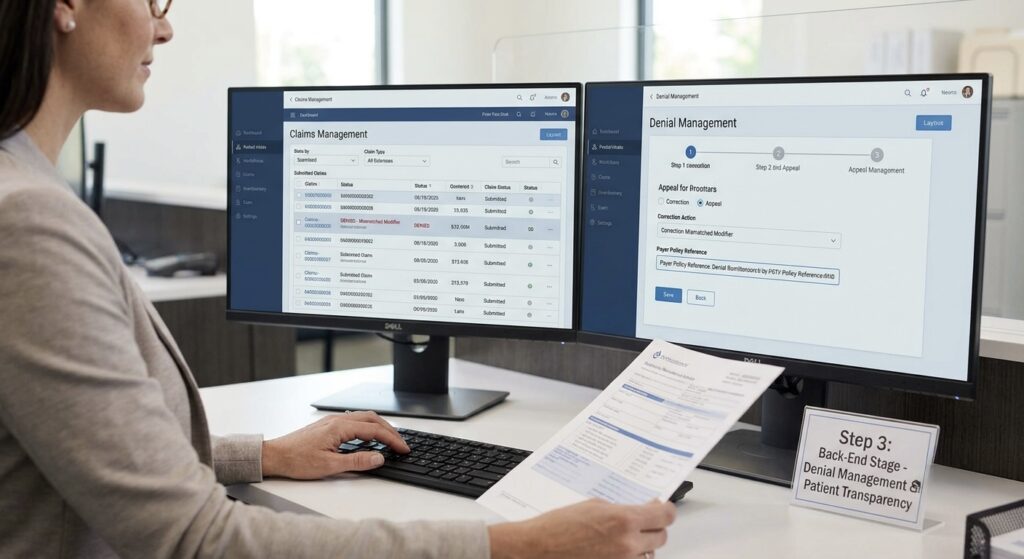
9. Denial Management
Not every claim gets paid on the first attempt.
Common denial reasons include:
● Eligibility issues
● Coding errors
● Missing documentation
● Authorization failures
● Timely filing limits
● Duplicate claims
● Incorrect modifiers
Effective denial management identifies root causes and resubmits corrected claims promptly.
10. Accounts Receivable Follow-Up
Outstanding claims require continuous monitoring.
Billers:
● Contact insurance companies
● Appeal denied claims
● Resolve payment delays
● Follow up on unpaid balances
● Track aging reports
Strong A/R management improves cash flow significantly.
11. Patient Billing
After insurance processing, remaining balances become patient responsibility.
Patients receive statements explaining:
● Insurance payments
● Remaining balance
● Payment options
● Due dates
Clear communication encourages faster collections.
Common challenges in medical billing
Healthcare organizations frequently encounter obstacles that impact reimbursement.
These include:
● Frequent coding updates
● Complex payer policies
● Staffing shortages
● High denial rates
● Documentation deficiencies
● Compliance requirements
● Delayed reimbursements
● Patient payment collections
Professional billing teams help overcome these challenges through specialized expertise.
How Medical Billing Improves Revenue Cycle Management
Medical billing is one of the most important components of Revenue Cycle Management (RCM).
An optimized billing workflow helps providers:
● Increase collections
● Reduce administrative burden
● Improve operational efficiency
● Shorten reimbursement cycles
● Lower claim rejection rates
● Enhance financial reporting
● Strengthen compliance
The result is a healthier financial future for the practice.
Technology in Modern Medical Billing
Today’s healthcare organizations increasingly rely on technology to improve billing performance.
Popular solutions include:
● Electronic Health Records (EHR)
● Practice Management Systems (PMS)
● Clearinghouses
● AI-powered claim scrubbing
● Revenue analytics dashboards
● Automated eligibility verification
● Robotic Process Automation (RPA)
● Payment portals
Technology reduces manual errors while increasing productivity.
Benefits of Outsourcing Medical Billing
Many healthcare providers outsource billing to experienced Revenue Cycle Management companies.
Advantages include:
● Reduced operational costs
● Certified billing professionals
● Improved collections
● Lower denial rates
● Faster reimbursements
● Scalable services
● Compliance expertise
● Better reporting
● More time for patient care
Outsourcing allows providers to focus on medicine while experts manage revenue.
Best Practices for Successful Medical Billing
Healthcare organizations can maximize reimbursement by following proven best practices.
- Verify insurance before every visit.
- Document services accurately.
- Use certified medical coders.
- Submit claims promptly.
- Review payer policy updates regularly.
- Monitor denial trends.
- Perform regular billing audits.
- Follow up on unpaid claims consistently.
- Educate staff continuously.
- Utilize billing automation whenever possible.
Key Performance Indicators (KPIs)
Successful billing departments monitor performance through measurable metrics.
Important KPIs include:
● Clean Claim Rate
● First Pass Resolution Rate
● Days in Accounts Receivable
● Net Collection Rate
● Denial Rate
● Claim Acceptance Rate
● Average Reimbursement Time
● Patient Collection Rate
● Aging Report Performance
Tracking these indicators helps identify opportunities for continuous improvement.
The Future of Medical Billing
Healthcare billing continues to evolve through innovation.
Emerging trends include:
● Artificial Intelligence
● Predictive analytics
● Machine learning
● Automated coding assistance
● Real-time eligibility verification
● Cloud-based billing platforms
● Intelligent denial prediction
● Robotic Process Automation
These technologies are helping providers reduce costs while improving financial outcomes.
Conclusion
Medical billing is far more than submitting insurance claims—it is a comprehensive financial process that determines the financial health of every healthcare practice. Accurate billing, timely claim submission, effective denial management, and consistent follow-up are essential for maximizing reimbursements and maintaining a strong revenue cycle.
As healthcare regulations become increasingly complex, providers need efficient billing systems and experienced professionals to navigate insurance requirements, reduce administrative burdens, and protect revenue. Whether managed in-house or outsourced to a trusted Revenue Cycle Management partner, a well-optimized medical billing process empowers healthcare organizations to focus on what matters most: delivering exceptional patient care while ensuring long-term financial success.
Leave a Reply